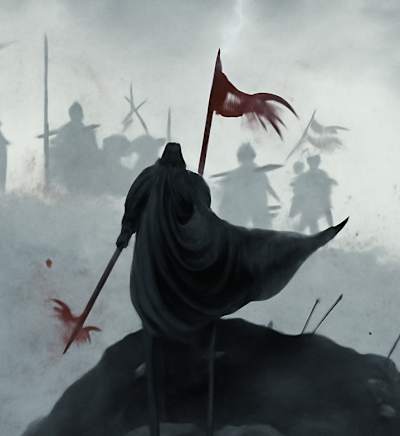
He was one of the first pieces I was taught to carve. It is a simple figurine wearing flowing robes. This amulet is very popular with carvers because it is quite simple to make and has a certain beauty that appeals to buyers. It follows a carving style called hàn bā dāo, which developed during the Hàn Dynasty. Craftsmen in China have been carving his likeness as a pendant to ward off evil spirits and bad luck for more than two thousand years.
The more I learned about this legendary warrior, the more fascinated I became. There are many stories surrounding him. My favourite tells of a child who, by the age of ten was already six feet tall and enormously strong. He had such a huge appetite that his family had difficulty feeding him. When imperial soldiers came recruiting, they lied about his age so that he could enlist and give the army the problem of providing him with enough to eat.
He soon gained a reputation as a fearsome warrior. His future was assured when he saved Qín Shǐ Huáng's life. Legend has it that the emperor was walking in the forest deep in thought, trying to work out strategies for his next military campaign, when a tiger attacked him. Wēngzhòng leapt to his defence and killed the beast. It was after this that the emperor made him his personal bodyguard.
Not happy with being a mere bodyguard, Wēngzhòng persuaded his master to let him lead his armies in a campaign against a fearsome tribe threatening the northwestern borders of the Qin empire. It is said he had such prodigious strength that he threw the heavy Chinese spears into the ranks of the enemy to kill them. Until this time, the spear was seen only as a weapon of hand-to-hand combat and was never thrown.
Legend also has it that at one point, he pulled an enemy general from his horse, killed him, then ripped the horse into pieces with his bare hands and used the pieces to batter his opponents to death. It is said that he was such a terrifying sight the tribesmen he faced believed him invincible and worshipped him as a god.
When he died, the emperor had a statue of him placed in front of his palace so that he could continue to protect him even after death. In a variation of this story, after he died several huge statues were placed on the great wall protecting the northern borders of the empire to deter the tribesmen from invading again. The statues were made from the vast arsenal of bronze weapons that Qín Shǐ Huáng captured from his enemies during the wars he waged to create his empire.
The central character in my new fantasy trilogy, Ox, is based on Wēngzhòng. The novels are set in an alternate China during the late Warring States period.